Thursday, April 8, 2010

dichotomies and generalizations: the lifeblood of stereotypes


Hi there!

This guy is a Black-throated Canary, or Crithagra atrogularis, isn't he beautiful?  We have tons of them and they make me deliciously happy.

Because I am a pea-brain and have had a lot of practice categorizing things according to differences, I'm afraid this bad habit has come with me from the States.  Some casual observations I have made, unfortunately, are categorized below:

In middle-class America, siblings usually don't help their younger siblings pay for their education; in rural South Africa, it is quite common to find older siblings financing their younger siblings' education.

In middle-class America, we leash, exercise and feed our dogs well; in rural South Africa, we starve our dogs, chain them to a tree, and have them as sentinels in our yards.

In middle-class America, we contain our domestic animals (cattle, donkeys, goats); in rural South Africa, we let domestic animals roam free.

In middle-class America, most documents are composed on a computer; in rural South Africa, most documents are hand-written.

In middle-class America, we have a cutting board for raw meat, one for garlic and onions, and one for everything else;  in rural South Africa, we use the table top.

In middle-class America, we dress for comfort rather than fashion.  In this way, we wear comfortable shoes and practical clothing.  In rural South Africa, we dress for fashion, which has us wading in 6 inches of dry dirt (or wet mud, depending the weather) in our stilettos and our cleavage busting out of our blouses.

(I do acknowledge here that fashion is indeed very important to many women in the US, and that style often trumps comfort in the US as it does in rural SA.)

In middle-class America, we have annual shopping trips to outfit our school with a wonderful variety of well-made, colorful clothes; in rural South Africa,  a school uniform is highly prized and often the most expensive cost a household assumes.

In middle-class America, these same annual shopping trips also procure a wonderful variety and abundance of all kinds of colorful and fun school supplies; in rural South Africa, a standard pencil (with no eraser) and the drabbest of cardboard covered "activity books" are supplied.

In middle-class America, we use a three-hole punch; in rural South Africa, we use a two-hole punch.


In middle-class America, we ask students questions to stimulate critical thinking; in rural South Africa, we tell learners what they should be thinking and believing.

In middle-class America, college students generally come to class as expected; in rural South Africa, college learners often do not come to class as expected, and any excuse seems honorable for an absence.

In middle-class America, we have periods at the ends of our sentences; in rural South Africa, we have end-stops at the end of our sentences.

In middle-class America, indoor plumbing is standard; in rural South Africa, indoor plumbing is exceptional.

In middle-class America, our greetings in English vary: Hello, how are you?  What's up? How have you been?; in rural South Africa, our greetings in English are standard and do not vary: "Hello.  How are you?  I'm fine, thank you. And how are you?"  (And any variety in greetings in English, we rural South Africans find hilarious.)

In middle-class America, we tend to write our dates in this manner: 04/08/2010; in rural South Africa, we tend to write the dates like this: 08/04/2010.  (Is it already April 8th?!!  Eish, my holiday was too brief!)

In middle-class America, most of our teaching course work has moved to computers and even on-line; in rural South Africa, most of our course work is done by hand.

In middle-class America, health hazards like raw sewage bubbling from the ground, or whole living areas being without water are considered health emergencies; in rural South Africa, these same health hazards are not regarded as urgent and barely become topics of conversation.

In middle-class America, we typically indent a paragraph; in rural South Africa, to find an indented paragraph in any of their learning materials is quite a find.

In middle-class America, teachers seem to have lost a once held, high regard of their community members; in rural South Africa, teachers are some of the most highly regarded by members of the community.

In middle-class America, passive voice is taught to be avoided; in rural South Africa, passive voice is taught painstakingly.

In middle-class America, our college kids are treated as adults; in rural South Africa, we treat our college kids as children, even locking them out of their dormitories so they are "forced" to attend class.

In middle-class America, we have discontinued the use of corporal punishment in schools; in rural South Africa, although corporal punishment is outlawed, we continue to use it.

In middle-class America, it is somewhat acceptable to make mistakes and be forgiven as a human being; in rural South Africa, to make mistakes publicly is the worst thing anyone can do.

In middle-class America, we typically value function over form; in rural South Africa, we typically value form over function.

Just some musings for a middle-class American pea-brain, and closing with another lovely sunset!  See the moon?

Soon, Karen


photo credit for black throated canary:
www.fiveprime.org/hivemind/User/Pius%20Mahimbi

between-term (Easter) holiday


After our training at the end of March, we returned to our sites with the 2-week between-term holiday (Easter) already in progress.  As is often the case, if we have time to travel after a training, many volunteers opt to travel.  Many of our Peace Corps volunteers travelled from Rustenburg to Sabie, South Africa, a great place to see the sights of Kruger National Park and Blyde River Canyon.

I, my usual boring little self, wanted to return to my site.  :-)

There were several reasons for my wanting to return to site: a) I've discovered that holidays are a delicious time to be living on my college campus as all students have gone away for holiday and it is blissfully quiet; b) I've horribly regretted the community garden because I've been swamped with school and was quite looking forward to having my hands in the soil; c) we had this dreadful quarterly report for Peace Corps needing filing by April 1; and d) I wanted time to prepare for my term two classes, now that I know what I'm doing in regards to teaching.

So, after a wonderful weekend trip visit with my friends Tim and Liz, I returned to my site.  Once here, I was horrified to learn that a very, very large church group had booked the campus, including the dormitories, and would be my housemates for the ENTIRE week of Easter.  They were as boisterous, if not more so, than the college kids ever are.  There went one week of solitude.

And, to make matters worse, unfortunately for me, I've not felt myself since returning to site, and have not felt up to working in the garden.  To make this disinterest worse, the garden is woefully overgrown with weeds and any hope of mulching it with yard debris was crushed when I realized that the yardmen were careful to burn all yard debris before leaving for holiday.  Grump!

I did the dreaded quarterly report for Peace Corps, hoping it would take a few minutes.  It took four hours!  I did this lovely task on Easter Sunday.  :-)

And here I am, into days away of the new term beginning, and still not feeling up to the task of preparing my classes.

At first I thought I was getting physically sick: overwhelming fatigue, sore throat, chills, loss of appetite, etc., so off to bed I went for a couple of days.  I did the whole garlic/cayenne pepper thing (am sure I smell absolutely LOVELY) and have drunk gallons and gallons of herbal tea, especially designed for this type of thing and faithfully mailed to me by a family member.

So, I did the stay in bed thing for a couple of days, the sore throat went away but I was still left with the fatigue and loss of appetite.  I forced myself out to the garden, hoping it would help, but it didn't.  Another volunteer visited yesterday and we walked to the post office and that helped a bit, I think.

So, the only big task I have left of my holiday is course preparation, which is feeling urgent now, since courses resume on Monday.  I'll pull it out, I'm sure, as I always do.

The other thing that is very likely to be going on, is I crash and burn after an intense round of work or crisis.  At the end of last term, I knew I was over-working and not taking care of myself, but I kept my eyes on the prize and knew the end of the term was coming, so I kept pressing.  When the term finally concluded, off I went to training for a week, and needed to keep my momentum going even further for Pilanesberg.

So, these last two weeks may simply be the colliding of the train cars piling up on me since the speeding car had stopped.

But I do have some photos to show you.  The above, is one of my ever-ongoing, jaw-dropping sunsets.  Isn't it lovely?

And below are some snaps of my barren herb bed and how it fared this season.  I must confess that I planted very late in the season, when it was already too hot and too dry, so my herb beds didn't fare well.  Marigolds did well though, eh?  And I was also thrilled that the "weedy thing that I didn't know what was" turned out to be borage. Although borage is considered an undesirable to some gardeners (because it is a determined grower), it does attract bees and other beneficials.  Why I am especially excited is that the flowers are edible and I'm hoping to convince the hospitality program to add the flowers to their lovely dishes as a garnish.  And borage is hardy and practically indestructible, so now that it is established, I should have borage for many years to come now!  :-)


And below is the only living thing remaining from my mulching experiment with the village woman and her tomatoes.  I planted a marigold as natural pest control and, as you can see, it thrived.  The tomatoes did not, largely in part I like to think, because she had me remove the protective mulch.  But I think the photo demonstrates how the mulch was effective with weed control.  See all of the bare, brown dirt around the marigold?  And all the weeds growing in the background?  Guess where the mulch was?


And below is a shot of my Setswana tutor's campaign poster.  He's running for a student government position.  I particularly appreciate his motto, "Together we can steal more." Nice.


And lastly, the photos below show the how of South African rural village landscaping.  The  "lawn" on the left has been cleared to expose only the red dirt under the grass line.  Most rural South African yards are landscaped in this way.  The villagers remove any grass or anything growing so snakes have no where to hide and can be easily seen.  (No one currently lives in the "portacamp" on the right, hence the grass is allowed to grow.  They call "trailers" or "mobile homes" portacamps here.)


Off to prepare for term two classes!

Soon, Karen

Monday, April 5, 2010

still more on food and eating and something of a rant


I'm still experiencing the learning curve on eating healthily in South Africa. I think I’m making significant progress. As with everything else here in South Africa, it has taken awhile.

I've spoken before about how fresh foods are significantly more expensive than pre-packaged, snacky, food-products and about how I'm spending most of my living stipend on buying fresh food. But I’m learning some tricks on how to make the food money go further.

Another volunteer pointed out to me a previously untried grocer in my shopping town. I was delighted to find all of my usually procured foods at a markedly cheaper price. I was very, very happy until I discovered bugs in my food.

As I went happily about using my much less expensive oats, rice, barley and such, I noticed that every one of those products was full of those small, dark weevils that one finds occasionally in dried grain products. Not very appetizing, to say the least!

It took me awhile to figure out my problem, and decided it was the cheap grocer. I’ve since returned to the pricier, yet higher quality grocers, and have found my bug problem to have disappeared. Also, the pricier grains usually come in better packaging, a sturdier plastic, which better keeps bugs out.

Initially, I was trying to support my local grocer, but became more and more dismayed at paying three times the price for rotten food. (Not surprisingly, I discovered that my village grocer was buying the marked-down produce from the grocer that was selling the vermin-infested grains.) So, I’ve since switched to buying only soap products and other non-perishables from my local grocer, and saving my pennies for fresher produce available in town. In this way, I keep some money in the village but have fresher, more wholesome food for myself.

I’ve also been keenly interested in how other volunteers are faring with their living allowances, particularly in regards to their food budgets. At first, I was dismayed when my informal poll indicated that other volunteers were doing just fine with their living allowances, thank you very much, and ending the month with more than half of their monthly funds remaining.

I was aghast! What in the world was I doing wrong?

I later learned that the initially polled volunteers were of the “younger” in age group, and probably saved their stipends because they are young enough to thrive on inexpensive boxes of crackers, candy, and the like.

Much later, after I talked to some of the more older volunteers, (but not much older), I learned that yes, they too, were struggling with having enough stipend to get by, especially in the food category.

A brief aside: When I was volunteering in Alaska, I was readying myself for a 3-day hike in the mountains. There was a young guy to accompany us, and I was horrified to learn that he would only be bringing “trail mix” along to nourish his body for the 3-day hike. When I expressed this concern to my supervisor, she remarked, “Kids do this all the time.” So, I stood corrected. And yes, he survived 3 days of strenuous hiking through the mountains, enduring freezing temperatures, three days of steady rain, and climbing mountains, although he did seek handouts from those of us that packed more substantial foods.


And of course, I’m reminded of my graduate school days, when I got by on nothing more than ramen noodles and peanut butter, so yes, I can see how some can survive on such a diet.

However, in my advancing age and increasing concern for my health, have adopted a healthy eating style and feel, well, that my life depends upon it.

When sharing news of unhealthful eating habits among some of the younger volunteers, a sympathetic volunteer commented, “I don’t want my Peace Corps South Africa experience to feel any more of an episode of “Survivor” than it already does.” Indeed.

This brings us back to the fact that as Peace Corps Volunteers, we’re expected to live in the same manner of the people that we’re living with.

I have something of a bone of contention with this, because we are “paid” to live a bit better than the pensioners in our community. The pensioners’ diet consists mostly of meat and mealie meal pap—a stiff porridge made from corn, because that is all they can afford. However, we work and live with educators in our community, and educators are some of the most highly paid people living in South Africa.

So, our stipend has us hoping to live on meat and mealie meal pap, but our community expects us to dress nicely, have a nice car, a nice house, etc.

It is a confusing contradiction, for all involved.

The politics of food and healthy eating has food manufacturers, food distributors, and dare I say governments?, throwing highly processed, addictive, harmful-if-eaten food products at the poor. In this way, the poor purchase the only food affordable to them, become sick from malnutrition, and live their lives needing expensive health care and ultimately die. We have this problem in the US as well.

Not surprisingly then, most of the people in the rural villages of South Africa are existing on “mealie meal,” a corn product that goes far on filling the tummy, but has very little nutritional value. Rural South Africans eat a lot of meat as well, and the instance of stroke and diabetes within our communities is alarmingly high. And as with the United States, school children are likely to be snacking on chips, sweets, and sugary drinks.

But I’m learning to eat well and have enough funds to eat well. I’m still eating fresh sprouts on a regular basis, the freshest and least expensive of all of my fresh vegetables: a small bag of whole lentils costs about R8 and sprouts weeks worth of fresh vegetables. I’ve found a way to purchase clean beans and grains and high-quality produce. I’ve found a non-fat milk powder to lighten my tea.

Again, back to the politics of food and eating. There are plenty of dried milk products available to everyone living in rural South Africa, but these milk products are FULL CREAM milk products. We know that full-cream milk is very bad for you, particularly in regards to heart disease. I finally found a non-fat milk powder, in, guess where? A grocer in the shopping town that caters to the wealthier class. (I won’t mention the color of the peoples’ skin that you see patronizing these stores, but leave it to your imagination and best guesses.)


Oh dear, I’ve gotten myself—and you—into quite the political rant.

All this to say I’m eating better and am making my pennies go farther. I’m learning, I’m learning, I’m learning.

To close on a somewhat lighter note, most of the oats I find in rural South Africa are the “quick” kind, the more highly processed kind. Well, I’ve long ago fallen for traditional oats and they’re something of a find here in rural South Africa. Most of us find “Jungle Oats,” a name brand that is refined. I’ve found the same name brand in the whole-oat form: “Tiger Oats.” I love these very much. Guess the only store where I can buy them?

Thanks for hanging in there with me—time for lunch!

Karen


Sunday, April 4, 2010

Parcels!! I'm a lucky girl!


I've changed my mailing address from the college to a PO box because there was a significant bottleneck while waiting for the college to a) go collect the mail from the post office, and b) finally sort the mail and then hunt me down to deliver it.


The post office is doing a fine job of keeping all of my mail in one place so I get it more quickly and more reliably. Also, the post office is holding anything addressed to me, whether it is addressed to the college or the PO Box.

Before I left for the most recent training, I received two packages from family members.

One was a package of herbs and spices, tea, dental floss, soap, and an always prized letter! One of the greatest ways I've treated myself is to ask for "favorite spices" from friends and family members along with a note of explanation on how the herb is enjoyed. For every meal, I have a different spice to look forward to. I remember thinking once, upon receiving some cinnamon, and sprinkling my oatmeal with it, "Does cinnamon always taste this good?” “Is this just exceptionally wonderful cinnamon?” “Or am I so taste-deprived, old mud would taste good at this point?"

This particular batch held a selection of whole spices: star anise, cloves, cinnamon sticks and other wonderful herbs to add to my daily dishes. I'm a lucky, lucky girl!

Another family member sent along some more "underly things" with a big batch of peppercorns, (yay! can never have enough of THOSE!), soap, and family photos. I feel wealthy in peppercorns!

When I returned from training, I was delightfully surprised with no less than FIVE packages awaiting me! (I think that is a record.)

One family member sent along some batteries for my book light, a LEO (favorite local publication from my favorite city!), vegetable bullion, herbal tea, and a Wild n Woolly pen I'm supposed to have my photograph taken with. (Wild and Woolly is a local, independently owned DVD/video store specializing in "hard to find" films. Apparently, customers are encouraged to take their promotional pens to the far corner of the world and have their photos taken with it for their website: http://www.wandwvideo.com/.)

This same family member also sent along a way-too-nice tea strainer that will have me feeling like Queen Elizabeth drinking tea out of her silver-plated tea strainer in dirt-town, South Africa!!

This particular package had a note and a gift of gardening gloves from my friends at Bunton Seed Company. Thank you! My bleeding hands feel better already! South Africa has some determinedly sharp and prickly weed seeds, and I've had a hard time trying to find adequate gloves!! These new gloves will work perfectly!

I took a seasonal job at Bunton's the spring before I came to Africa. Gosh, I guess it was LAST spring. It feels like a gajillion years ago... I wanted to work there because it is a reputed seed company and nursery; is within walking distance of my Louisville home; I was hoping I could learn more about plants, vegetables, trees, herbs, etc., and I was hoping to do was make some extra money for my African trip. Of all those things I accomplished except earning extra money for my trip. I spent nearly every extra penny buying plants! Silly me! I had a great time planting that spring tho!!

So thanks to Chloe and everyone at Bunton Seed!

Another family member sent me a package stocked full of fun reading material: a book on the Greening of Africa, several publications on my city's parks and upcoming festivals, local neighborhood papers, a Nature Conservancy, and stickers for the kiddos.

I'm happy to see that the organizations begging donations have switched from return mailing address labels to stickers I can use for school children! Woo hoo!

And then I had family members send several packages of school supplies after seeing promotional shows on American television for "Peace Corps Week," which I didn't even know existed. Apparently, it is held in the first week of March. My family saw a clip from Good Morning America and sent me parcels containing all kinds of school supplies: maps, atlases, pens, pencils, stickers, dictionaries--all fun, fun, colorful stuff. I almost can't wait to get back to school! (We're on Easter holiday until April 12.) The kids will be delighted. I am delighted!

And always appreciated are the ever-coming notes and letters. I have one family member in particular writing me of local and national news and events. She even supplies news of happenings in the sports world. (I, unfortunately, don't have a sport cell in my body.) I love reading news from home, ALL news from home, because it helps me feel as if I WERE home.

I'm a lucky girl!

Thanks to everyone for your ongoing support!

Soon,

Karen

Thursday, April 1, 2010

the Lion Park near Pilanesberg March 2010


On our way out of Pilanesberg, Palma overwhelmed us even further with a visit to a lion park very near a hotel where we had lunch. The lion park had lions of all sizes to see: we stared at a lovely male with a tremendous mane lounging in the shade with three (or four?) gorgeous females.


But the thrill in the lion park, for me, was entering the area where young lions are kept for petting and pictures. And of course, I have never been this close to a lion before.

Lovely shot of both Liz and Emily holding a baby lion. He seemed a bit grumpy (and squirmy!) so I passed. He didn’t like being petted either:

Me: Aaaaaaaaaahhhh. Lovely kitty.

S/he: I’m not a damn kitty!

Me: You’re right!

S/he: I’m a LION.

Me: You most certainly ARE A LION.

Playing with lions after a day of jaw-dropping beauty. I’m a lucky girl.

Soon,

Karen

Pilanesberg Game Reserve March 2010


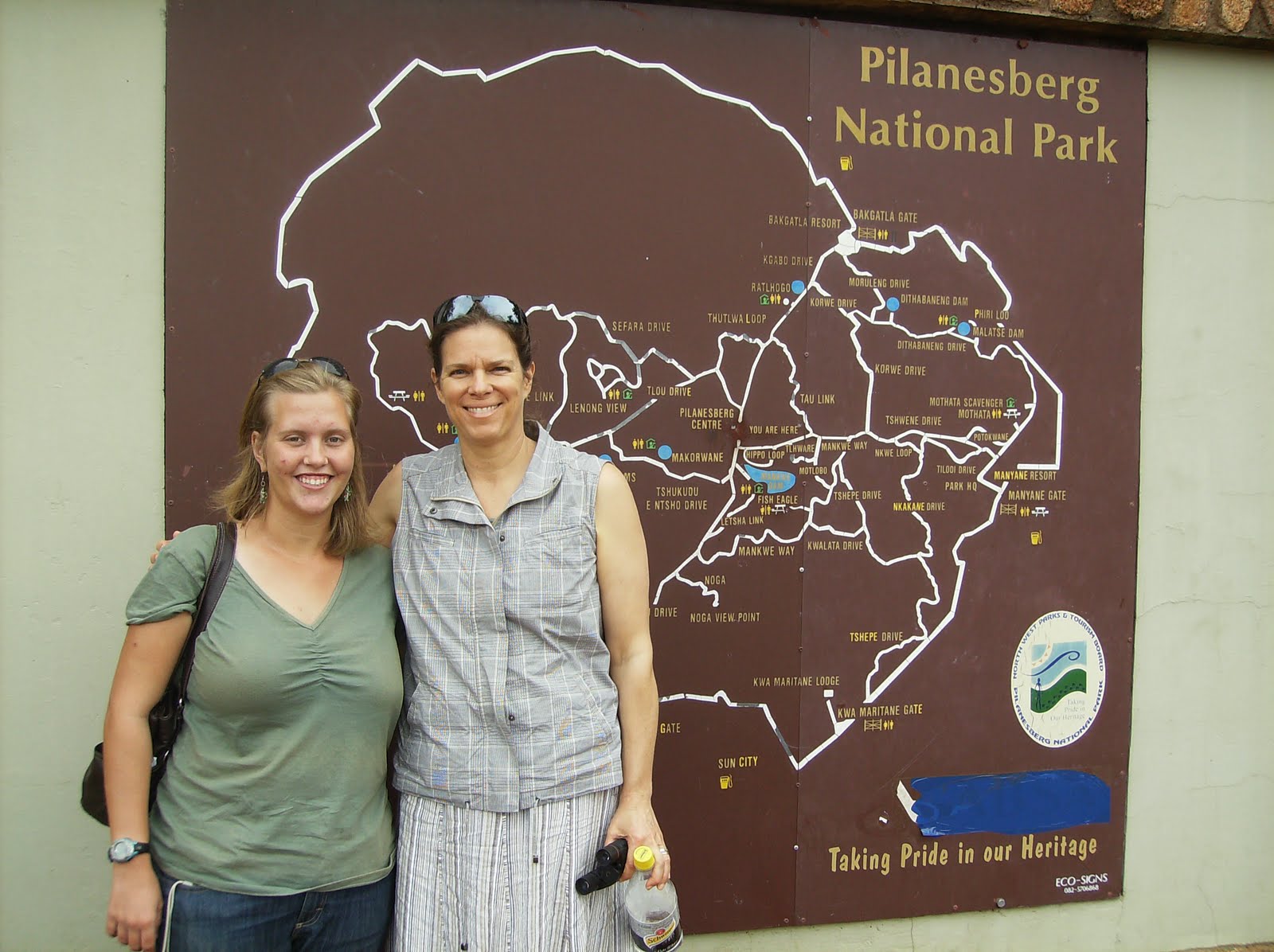
While I was excited to stay in luxurious hotel for a week, I was more excited about what would come after: my friends and fellow PCV’s invited me to their home to spend the weekend. My friends Tim and Liz, along with their very gracious and generous friend Palma, treated me to the most amazing weekend of my South African life to date: a tour of Pilanesberg Game Reserve.


(I’ve seen Pilanesberg referred to as a National Park on maps, but I’m told it is not.)

Let’s just say that I’m only now closing my mouth after having my jaw dropped the entire time.

Words can’t really describe how wonderful it was. We saw almost all of the animals to be seen there. It was truly amazing. Since it is a park full of wild animals, you’re not permitted to walk about, but rather you must drive in a car and remain in your car to do the wildlife viewing.

Palma has been visiting the park for years and is a very, very good tracker: she always knew where to go and where to look to find animals. Tim is very good as well and between the two of them, we were running from one group of wild animals to the next. It was truly amazing.

I kept waiting for Robert Redford and Meryl Streep to pop out of the bushes and often heard the soundtrack from Out of Africa playing in my head.

I kept remarking, “Finally! I feel that I am actually in Africa!!”

We had lovely meals throughout the weekend and Tim made the most divine omelet I believe I’ve ever had. And I was thrilled that Liz served me a beautiful salad that actually qualified as a salad. It was lush and delicious. (Apparently, South Africans view a salad as something small and insignificant, usually on the order of three tablespoons or so.) Liz’s salad was eye-popping!

Palma treated us to all kinds of fun and goodies and a viewing of The Gods Must Be Crazy. The latter is a comedy set in South Africa. It’s an older film, but I hadn’t seen it. It was fun. (This is the first film I’ve seen since coming to South Africa: since July 2009!!)

I know you want lists and pictures of animals seen. I have a few good shots of the animals I could get close to, but many are from a distance and not very good. Tim is exceptional with a camera and has wonderful shots of animals of Pilanesberg. To give him some privacy here, I will mention only his first name, but I will give you his website, and that will help you get to his photos:

http://www.jackspoon.blogspot.com/

I got several shots of warthogs. We had breakfast at the Pilanesberg Center and they serve food on a lovely patio overlooking a salt lick and a water source. Both of these are strategically placed to attract animals and such attraction provides excellent wildlife viewing (and good photo opportunities).

(A brief aside.) When I was a little girl, my family owned a cabin in the woods on Nolin Lake. We were lucky enough to visit our family cabin year-round. There wasn’t a lot to do during winter months, but we were young and there were four or five of us so we could usually find something to do. We would bundle up in layers and don wool jackets and hats and go hiking deep into the hollows left from the draining of the lake. (Nolin Lake is a reservoir built for water control.) We would always pretend we were “warthog hunting.” We never found our elusive warthogs, so you can imagine my satisfaction at finally finding one. (This one’s for you, Pap!)

It was exhilarating to sit and breakfast and see wild animals roaming about in the distance. We saw herds of varieties of antelopes along with wildebeests grazing while a lone giraffe strolled along the plain. (Again, soundtrack playing!) I could have sat there all day! It was amazing.

Tim also had wild birds feeding out of his hands. The wild birds know that they can beg handouts from dining guests and are tame enough to approach.

In our drives we came very near a springbok (the South African national animal (?)) and a wildebeest. We visited two “hides” to observe animals at a water site. One “hide” provided elephants frolicking on one side and hippos surfacing on the other. At this same hide, we saw a crocodile swim out away from us further into the lake. Amazing.

The next hide we visited we were treated with hippos coming up out of the water and onto the grass. Amazing.

It was an amazing, amazing day and again, my jaw set upon my chest the whole day.

Soon, Karen

Ps. For more on Pilanesberg, see their website at:

http://www.pilanesberg-game-reserve.co.za/


Life Skills Training at Sparkling Waters hotel near Rustenburg


We had our Life Skills training at the lovely Sparkling Waters Hotel near Rustenburg. We had an earlier training at the same location, but, knowing what to expect, I made the best use of my time and resources. (Play, play, play, relax, play, play, eat, eat, eat, play, rest, play, mostly. Also: sleep unworried about stinging, biting, critters under crisp, clean sheets knowing someone ELSE would make my bed in the morning.)


I also knew to expect wonderful, wonderful, bountiful food and three meals a day. I was determined to load up on meat and wonderful salads. This ended up being a mistake, as my body was accustomed to a simple diet and rebelled against the rich, delicious food.

We were to take our community “counterparts” to this training and I invited my counterpart from my primary school. To protect her anonymity, I’ll use her first name: Kelebogile. She is an educator that lives on the college campus, but teaches in the primary school. She helps me a great deal at the primary school.

Conveniently, her husband is the man “in charge” of the community garden, so it’s nice to have both of them as resources and they’re both conveniently located in the same house!

The first part of our training dealt with HIV/AIDS education. The speakers were two gentlemen doing wonderful, amazing things in distributing helpful and practical information to those living with or affected by HIV/AIDS: David Patient and Neil Orr. You can see more of what they are about at the following websites:

http://www.empower.co.za/

http://www.davidpatient.com/


They approach the disease with a whole health model, which I greatly appreciate. Their presentations were wonderfully informative and I felt I had great information to carry back to our community. These guys are doing great, great work in Southern Africa (and all over the world).


The last part of the workshop dealt with project design and fundraising to help volunteers and counterparts learn how to design and implement projects within our communities.


I loved staying at the hotel mostly because I could hike about in the wilder areas. Yay! I get to walk in the woods! It was beyond wonderful!

Also, I had a poignant evening one night when the hotel presented a concert by Simon and Garfunkel on a large screen. The concert was filmed from their famous 1982 (?) concert in New York’s Central Park. It was an overwhelming experience: to be in Southern Africa, in a resort hotel, with fellow Americans after living for six months in a rural village. I was so homesick during the performance that I ached. (Homeward bound…)

And lastly, I was somewhat charmed to learn that we had small toads in our HOTEL ROOM every morning. I would try to chase them out, lest they be killed by the cleaning crew. We were perplexed as to how they came in; at one point, we thought they were coming in from the large crack at the bottom of our main door. But, we blocked the door crack with a towel and they still came in. We could only surmise that they must be coming in through the open windows. (We had the bathroom window open along with the window above my bed.) I didn’t know toads could climb trees! Can they??

If you’d like more information on the hotel, see their website:

http://www.sparklingwaters.co.za/

If you’d like to see more photos of our training, including more photos of volunteers and counterparts, see my Facebook page (You need not be a Facebook member to view the photographs):

http://www.facebook.com/album.php?aid=59143&id=1239371142&l=ca2242ea95


http://www.facebook.com/album.php?aid=59139&id=1239371142&l=234e3e56ed


Soon, Karen